Saturday, 11 September 2010

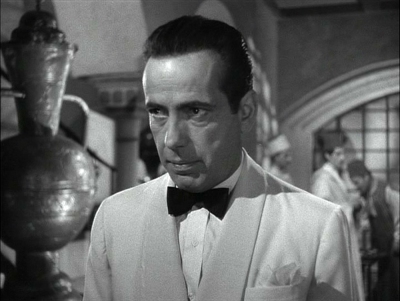
The Meaning of Bogart


Is the popularity of Humphrey Bogart currently languishing? In the 1960s, Bogey-worship reached cultish proportions. His persona – the romantic outsider – accorded perfectly with the iconoclastic spirit of youthful rebellion that characterised the 1960s. Having a poster of Bogart on the wall of one’s student bedsit was the modish cliché of the era – he was seen as a more cerebral, more mature James Dean-figure. It seems to me, however, that his iconic status and popularity are seriously diminishing.

He still has his adherents, but, like Existentialism and Northern Soul, he has been going out of fashion since his 60s zenith, even as his reputation as an actor amongst film buffs and critics remains very high, perhaps higher today than when he was alive. Go to a DVD shop, and you’re likely to find little else other than Casablanca and The African Queen. I’ve looked in many book-shops, but acquiring a biography of him is almost impossible without using the internet. You can find endless Audrey Hepburn, Cary Grant and Marilyn Monroe box-sets in HMV, but Bogie ones are poorly stocked. Shockingly, many of my contemporaries have not even heard of him, or if they have, they have not seen many or any of his films.

This is a very unfortunate state of affairs. To me, Bogart’s work contains a core of moral seriousness, of meaning, that makes him indispensable, absolutely worthy of his iconic status. He is, to put it simply, one of the most compelling figures in the history of film.

Much of his worth, I think, stems from the distinctive ‘Bogie’ persona he crafted for himself, which shaped the scripts he was given and the direction of his films. He was one of very few actors who probably had as much impact on the nature of a picture as the director, simply because of his identity and style. What was this persona, and how did it shape the meaning of his great films? In short, what was the meaning of Bogart?

The first observation to make is that the Bogart persona evolved only gradually, and finds mature expression only in a fraction of the films he made overall. When Bogart first started appearing in films, he was a studio workhorse churning out whatever potboilers the studio demanded in order to earn a bare living. Only gradually did the studios and their writers and directors begin to realise that Bogart was at his most compelling playing certain kinds of roles in certain kinds of films. His partnership with director John Huston really began to draw the best out of him in films such as The Maltese Falcon, Key Largo and The African Queen.

The Bogart persona is defined by two conflicting strands. The first and most obvious aspect of it is his cynicism and apparent selfishness. In film after film he plays characters who, at first sight, are basically jaded, who disclaim any idealistic or romantic notions, who have retreated to a position of self-interest and distrust; who are, in essence, out for themselves, having lost belief in anything bigger than their own individual desires.

The most famous example of this is the character of Rick in Casablanca, who initially tries to tread a path of neutrality between Vichy France/the Nazis, and the Resistance. He is, he proclaims, only interested in making money through his cafe, and, later on, in recapturing the heart of Ilsa (Ingrid Bergman), with whom he previously had an affair in Paris. He claims that he has no interest in fighting the Nazis, and is not prepared to help Victor Laszlo (the fine Paul Henreid), heroic resistance leader and Ilsa’s husband, escape from the Nazis – in fact, he wants to use the letters of transit out of Casablanca that he has acquired to escape from Casablanca himself with Ilsa, whom he still loves. As Rick puts it, “I stick my neck out for nobody!”.

It gradually becomes apparent that Rick may not be the cynical bastard he initially appears to be. Laszlo points out that he ran guns to Ethiopia in 1935 to help in the fight against the fascist Italians, and that he fought for the Republicans against Franco in the Spanish Civil War – in other words, previously he has always helped the anti-Fascist cause, the side of right and justice. He also allows the band to play the Marseillaise in the brilliantly tense scene in his cafe when Laszlo initiates an impromptu sing-off against the Nazi officers who are bellowing a German nationalist song, implying sympathy for the Allied cause.

The final act of Rick’s redemption comes in the famous final scene, when, after planning to escape with Ilsa and leave Laszlo to the depredations of the Nazis (indeed, it even seems that he will betray Laszlo by helping the police arrest him), he abruptly changes his mind and lets Laszlo escape. He even takes a personal risk, forcing Renault, the chief of police, to allow Lazlo’s escape at gunpoint. He thus sacrifices his personal desires – his love for Ilsa and desire to escape from the febrile atmosphere of Casablanca – for a greater cause. His reasoning is summed up in his stirring speech in which he observes that Ilsa must leave because she is vital to Victor, “the thing that keeps him going”, and that if she does not leave she’ll regret it, “Maybe not today. Maybe not tomorrow, but soon and for the rest of your life”. He sums it up by declaring that although he’s “no good at being noble...it doesn’t take much to see that the problems of three little people don’t amount to a hill of beans in this crazy world”. In other words, there is something bigger than himself, a cause worth making sacrifices for. His initial cynical posturing is shown up as a sham, a mask used to protect himself against disappointment. This underlying idealism is the second strand of the Bogart persona.

Rick’s final act of sacrifice is, I think, the fundamental point of the entire film. In its message of hope resides the film’s greatness. Its romance depends on an ending which, in a conventional sense, is ‘unhappy’, but which conveys the great moral that there is always a better and more ethical cause and course of action worth pursuing over mere self-interest. We should try to do the right thing, even when it involves sacrifice or transcending our selfish interests. This message derives all its potency in the film from Rick’s, and therefore Bogart’s, persona. It is only because Rick acts in an amoral, self-interested way to begin with that his final act of altruism seems significant and powerful – his change of heart is the film’s dramatic hinge. Without Bogart and its basically moral message, Casablanca would now be a half-remembered old film that no-one watches.

The message and functioning of the Bogart persona work in the same way in another of Bogart’s greatest pictures, To Have and Have Not, which was his first film with Lauren Bacall. The plot is similar to Casablanca. Bogart plays Harry ‘Steve’ Morgan, a jaded fisherman working in Martinique just after the fall of France in the summer of 1940. Martinique being a French colony, it is under Vichy control. The owner of the hotel in which Harry is living is a resistance sympathiser, who asks for Harry’s help in smuggling some resistance leaders to the island. At first, Harry refuses. He is interested only in running his fishing business, and will not risk helping the resistance, since he knows that if he is found out by the Vichy authorities he will end up imprisoned on Devil’s Island. When asked his sympathies by the Police Captain, he answers, “minding my own business”. Once again, he plays the apparently neutral, amoral individualist not interested in “sticking his neck out” for anyone.

However, when his money is confiscated by the Police Captain and he finds himself broke, he agrees to help the resistance in exchange for payment. In transporting the resistance fighter Paul de Bursac and his wife, Harry’s boat is attacked by a Vichy patrol vessel and de Bursac is shot and injured. They cannot get him to a doctor because the Vichy authorities are scrutinising his every move. Morgan, who has some rudimentary first aid knowledge, agrees to remove the bullet and help save de Bursac’s life. The Vichy authorities try to bribe Harry to betray the resistance members, but he refuses. Harry even overpowers the Captain of Police and forces him at gunpoint to free his alcoholic friend whom they are interrogating, as well as signing harbour passes for de Bursac.

Although Harry Morgan agrees to help at first out of financial necessity, he ends up going out of his way to assist the resistance fighters, as the Vichy authorities’ behaviour begins to offend his sense of justice. The mask of indifference and apolitical individualism once again falls to reveal a basic core of nobility. Asked by the incredulous hotel owner ‘Frenchy’ why he is helping them after his initial indifference, Harry answers, “maybe because I like you, maybe because I don’t like them”. To Have and Have Not does not have the grandeur or drama of Casablanca, but the basic message of a sense of justice trumping self-interest and neutrality emerges once again. The world-weary, hard-headed businessman has a change of heart and realises that basic human decency is something work taking risks for.

The third and last detailed example of the Bogart cynic-idealist dynamic I will explore is Key Largo, one of the fruits of the brilliant Bogart-Huston partnership. In this film Bogart plays a Second World War veteran, Major Frank McCloud, who goes to visit the father and wife of an old comrade who died while fighting with McCloud in the Italy campaign, James Temple (Lionel Barrymore) and Nora (Lauren Bacall). They run a hotel in Key Largo. When McCloud arrives, it quickly becomes apparent that the sinister individuals staying at the hotel are not, as they insist, there for a fishing trip, but are instead gangsters led by the notorious fugitive hood Johnny Rocco, played menacingly by Edward G Robinson. The gangsters are there to complete a big deal, and their identity is quickly revealed by McCloud. They drop the fishing trip pretence, and take McCloud, Temple and Nora prisoner at gunpoint.

At first, once again the Bogart character appears to be selfish and insular. When given a chance to shoot Rocco and send the gangsters packing, he refuses, affecting indifference. He pretends not to care, declaring that “one Rocco more or less isn’t worth dying for”. He is cynical about the idea that Rocco might get his comeuppance, shouting to Nora, “Rocco wants to come back to America, let him! Let him be President!” His apathetic and self-serving attitude is summed up by the typical statement that “I fight nobody’s battles but my own”, a sentiment almost identical to that of Rick in Casablanca and Harry in To Have and Have Not.

However, once again Bogie reveals his true colours and reverts back to the side of justice and decency. Rocco humiliates his alcoholic mistress and causes the murder of two innocent native Americans, which snaps McCloud out of his indifference. He had given up his old hope, for “a world in which there’s no place for Johnny Rocco”, but in the face of such cruelty he revives it, firstly by risking his life to help Rocco’s mistress and then by overpowering the gangsters when they force him to pilot their boat back to Cuba, where Rocco lives in exile. Although McCloud has, intellectually at least, given up on his idealistic hope that “we’re fighting to cleanse the world of ancient evils”, his instincts betray his apathy and he does the right thing. As Nora puts it, “your head said one way, but your whole life said another”.

As you can see, the structure of these films is basically the same. World-weary, cynical Bogie, who claims to have given up on his ideals and his belief in moral behaviour (both personally and politically) for a belief in self-reliant, self-serving amoral individualism, is given a choice; does he do the right thing at some personal risk, or act in a callous and selfish way? Does he stick out his neck, or not? Initially, he acts as his jaded persona would imply, but then he always has a change of heart, ends up abandoning his indifference, and does the right thing. Of course, not all of his film follow this structure (although many do, including The African Queen where Charlie Allnut agrees to ‘stick his neck out’ for Rose in her attempt to help the British war effort, despite his misgivings), but the Bogie persona is given its most concentrated expression in the films underpinned by this dynamic of moral redemption and sacrifice.

The appeal of these themes, which are so brilliantly symbolised by Bogart, can scarcely be seen outside of the context of the era in which the films were made. The despair and apathy that constitutes half of the Bogart persona reflects the circumstances of the 30s and 40s. Ravaged by the Great Depression and the initial successes of Fascism, the world reflected and seemed to reinforce the characteristic Bogie cynicism and abandonment of hope. In Casablanca, Rick’s hopelessness is partly a product of his experience of the defeat of the anti-Fascist cause in Ethiopia and Spain. The initial selfishness and indifference of Bogart in all of these pictures symbolises the despair and fear that engulfed the world of Bogart’s era, a world in which it seemed that all the great ideals and causes had been lost, and so personal survival was the best that could be hoped for. Bogart’s recurrent redemption, his consistent changes of heart, reflect the victory of will and hope over despair that crystallised itself in the war effort, and more specifically, in the American context, FDR’s determination to tackle the Great Depression and also enter the war on the Allies side (it is not a coincidence that Bogart was a supporter of the Democrats and campaigned for FDR).The saviour of Bogey’s soul in the films is an allegory for the saviour of the world from the terrors of Fascism and poverty. It is not difficult to see the appeal of such allegories of sacrifice and morality to audiences making their own sacrifices to win the war.

Indeed, there is a sense in which Bogie becomes a personification of the USA itself. His initial reluctance to involve himself in other people’s battles, his self-reliance, seems to me to be a metaphor for American isolationism and reluctance to get involved in the Second World War. His eventual determination to do the right thing reflects FDR’s attempts to bring the USA in the war, and even the Marshall Plan and post-war reconstruction. I may be in danger of reducing Casablanca to a series of crude national stereotypes, but the character of Rick is clearly, on one level, meant to represent America, just as Laszlo represents Occupied Europe and Major Strasser represents Nazi Germany. In Key Largo, Johnny Rocco is clearly a symbol of the thuggishness and cruelty of Nazism, and Bogart’s eventual conversion to standing up to Rocco, to making a “world in which there is no place for Johnny Rocco”, seems to me to be a metaphor for US involvement in the War. There is, of course, a sense in which this narrative is a piece of self-justifying American propaganda, because the USA only entered the war in 1941 by accident, due to Pearl Harbour and Hitler’s stupid decision to declare war.

It is not fair, however, to reduce the appeal of the Bogart persona and his greatest films to crude political allegory. The figure of Bogart the stoical, self-reliant loner, stalked by disappointment and cynicism, resonates on a far more personal level. Bogart’s characters’ selfishness and apathy is always a product of weltschmerz, of disillusionment, and such disillusion is also a product of personal disappointment that has universal appeal. Rick in Casablanca is a haunted figure not just because of the rise of Fascism and the fact that he is tired of lost political causes, but because he has a broken heart after losing Ilsa. There is a very strong indication that Harry in To Have and Have Not has suffered romantic disappointment – ‘Slim’, the love-interest played by Bacall, asks Bogart, “Who was the girl?” A baffled Bogart replies, “Who was what girl?”, to which Bacall responds, “The one who left you with such a high opinion of women”. Charlie Allnut in The African Queen is clearly a depressive loner, one who finds redemption in the arms of Katherine Hepburn. The treatment of love in the key Bogart films doesn’t always seem consistent. Sometimes romantic love itself is presented as the higher, moral end, which Bogey reaches despite his own cynicism, comparable to the higher moral or political end that Bogey always ends up on the side of, and sometimes love is sacrificed for that higher moral or political end – the former is the case in The African Queen and To Have and Have Not, the latter in Casablanca. However, the appeal of the Bogie persona on this more personal level consists, just as in the more political dimension, in the idea of the disappointed idealist reconciled, perhaps reluctantly or even ill-advisedly, but nonetheless admirably, to his original ideals. The ideal is of love and connection to another individual on the personal level, and of moral connection to the wider community via values such as decency, fairness and justice on the political level. Either way, Humphrey Bogart is the cynic as disappointed romantic par excellence. The romance, the idealism, of course, gains its power from the cynicism, the struggle against its irresistible pull. Straightforward idealism untainted by moral ambivalence and conscientious struggle is no idealism at all.

These themes are not all that is appealing about Bogart. His outsider mentality, which permeates from his real personality into his film roles, gives him a rebellious tinge. The characters he played tended to be infused with impatience with pretension and authority – Bogie plays by no rules other than his own. Since we know that Bogart was notoriously outspoken in his dealings with studios, and renowned as a bit of a firebrand, we can once again see Bogart’s fiction and reality merging into one. Furthermore, his persona cannot stand the credulous, emotionally craven or dependent. This gives his roles a sexual charge that is absolutely unmistakable, particularly as it manifests itself in another characteristic that he himself had, that is, attraction to strong –willed, feisty women. This reaches its peak in the films he made with Bacall, which simply fizzle with incredible sexual chemistry. The scenes in which Bogie and Bacall flirt, particularly the scene in The Big Sleep with the outrageous horse-racing innuendo (“A lot depends on who’s in the saddle”) and the scenes in To Have and Have Not with the cigarettes and whistling double entendre (“You just put your lips together and blow”), are probably the most erotically charged scenes in the history of cinema (the sexual aspect of Bogie is reflected in Woody Allen’s excellent picture Play it Again, Sam, in which Bogart appears as a kind of ghostly romantic mentor to Allen’s hopeless neurotic). Another compelling aspect of Bogart was the fact that one also gets the sense that he was an intelligent and interesting person beneath the acting roles. The fact that he was a very good chess-player (the chess scene in Casablanca was his idea), almost of master strength, adds to his almost never-ending layers of cool.

However, the meaning of Bogart, and the basis of his enduring importance, is undoubtedly his cynic-as-disappointed-romantic persona, which is timeless. So long as human beings pitch hope and will against disappointed ideals and disillusion, those classic films will always be tremendous works of art. Indeed, in a world marked by deep uncertainty and instability, in which all the best causes are the lost ones and a fatalism and despair comparable to the 1930s is emerging, maybe Bogart’s time is coming again. I hope so.

Friday, 9 October 2009

Labour confounds expectations in March West

North East Cambs Labour this evening defied gloomy expectations in a by-election in March West by smashing the Lib Dems and coming a respectable second. The Tory won 830 votes, Martin Field, the Labour candidate, won 460 votes, and the Lib Dem got a measly 250 votes.

Bearing in mind that in the County Elections earlier this year Labour received 177 votes in the same ward/division, and the Tory got 1175, this is a good result. The Lib Dem vote also went down 27 votes from 277. I'm no psephologist, but this is a big swing to Labour.

Previously, on Vote2007.co.uk all of the so-called 'experts' predicted that Labour would get less than 10% of the vote. We actually got 31%, almost double the Lib Dem percentage.

Why did Labour perform so unexpectedly well? Firstly, we fought a hugely energetic and enterprising campaign. Peter Roberts, Labour PPC for North East Cambs, and Chris Jones organised a focused and professional effort, which saw us knocking on 1500+ doors in a month, putting out 3 leaflets and a day of poll, and conducting a decent knocking-up operation on the day. All credit to them for throwing their energy into such a seemingly hopeless cause.

Perhaps the most important factor was the sheer quality of the candidate. Martin Field is a long-serving Geography teacher at the local Neale-Wade community college. He helped set up Young People March, a scheme designed to give youngsters in March something to occupy themselves. He has chaired Fenland Victim Support. He is Chair of Governors at a local primary school. The number of schemes and projects he has selflessly dedicated himself to for the good of the community is tremendous. He is the sort of bloke without whom local communities and civil society would wither on the vine. He's also a really nice man personally, feeding and watering us activists without complaint. Canvassing, it became a running joke that virtually everyone we talked to had either been taught by him, or had children who had done; the reaction to him in this capacity was overwhelmingly positive;he must be one hell of a teacher. If he had been an independent, he would have stormed home to victory.

Another noticeable factor was the quality of the literature we put out. I say without a shadow of a doubt that the leaflets put together by the Roberts/Jones duo were superior to anything the national party managed to put out in the whole Norwich North by-election - glossy, full colour, well-designed, with sharp, to the point copy. I'm not sure whether this says more about Peter and Chris - the Batman and Robin of Cambridgeshire politics - or the national party.

Anyway, the by-election was great fun and a real blow for the Lib Dems. Without the Lib Dems, Labour would have stood a chance of actually beating the Tory. It shows what a spent force the Libs are in North East Cambs, and gives impetus to the argument that only a Labour vote can beat the Tory in Fenland.

Wednesday, 7 October 2009

Times are Toff for Cambridge University Tories

Many Cambridge students may have noticed that Cambridge University Conservative Association (CUCA) has been distributing a university-wide ‘Fresher’s Guide’ in the past week or so. Glossy, full-colour and ten pages, it shows just how well-funded the Conservative Association, and indeed the Conservative Party in general, is. Interestingly, on the first page CUCA gives ‘special thanks’ to Jeffrey Archer, presumably for the production of the booklet. Whether the help given was financial or otherwise, it is obviously true that CUCA have been accepting aid from a convicted criminal, perjurer, liar and fantastist, possibly the most discredited and hated man in British politics.

This is nothing to the content of the booklet. It contains articles on the best options for buying champagne in Cambridge, an article giving (extremely pretentious) tips on formal wear, including tips on handkerchiefs as fashion accessories, cummerbunds and bowties, as well as advice on black and white tie, reviews of a range of restaurants including swanky ones most normal students could only dream of attending, and a guide to tying a bow tie. It projects a fantasy image of a gilded, privileged Cambridge that only ever existed, insofar as it did at all, for a small number of extremely wealthy people. It may appear to be tongue in cheek, but given how seriously CUCA members take these absurdities (as I hear from a source I have inside CUCA), it is not.

In the context of a global recession where ordinary working people are losing their jobs and homes, the Tories are clearly most interested in flaunting their wealth and privilege, and frankly it makes me sick. I’m most worried about my mum losing her livelihood and home if her public sector job gets the axe under the Tories. The Tories live in a cloud-cuckoo land where one can ‘save water’ by ‘drinking champagne’, where the colour of one’s cummerbund or silk handkerchief is more important than making a living, where mummy and daddy can pick up the tab for nights of orgiastic excess.

What kind of image does this project to working class freshers or potential applicants to Cambridge? It re-affirms every stereotype bandied about concerning Oxbridge snobbery, elitism and Brideshead-style excess. CUCA is single-handedly going about the task of setting back access by about 70 years. Cambridge, the Tories imply, is a place for ‘people like us’, people who can afford and enjoy posh restaurants, champagne and white tie. It’s not for the likes of you, people from ordinary working class backgrounds – this is the whole message of CUCA’s sermon. In short, they have squarely positioned themselves as a glorified social club for wannabe toffs, social climbers and minor aristocrats.

The Labour Club is campaigning for the People’s Charter, a manifesto for change that will give ordinary working people a fair chance, a sane economy and a new moral start. We are concerned about bread-and-butter issues because we know that life isn’t one long round of white-tie dinners, champagne receptions and aristocratic indulgence for most people. In the context of a Tory Party led by a small clique of Old Etonians who frequented the Bullingdon Club, that bastion of wealth and privilege in Oxford, CUCA’s cavalier and supercilious attitude is perhaps hardly surprising, but it is shocking and shows just how profoundly alienated from the lives of ordinary working people the Tory Party is.

Wednesday, 16 September 2009

Partisanship, democracy and local elections

I am as partisan politically as the next party activist. I would never seriously contemplate voting anything other than Labour, unless there was no Labour candidate on the ballot paper (which is highly unlikely, as I would probably be the paper candidate myself if I lived in the ward). Even though I have problems, to say the least, with government policy, and am unlikely to ever agree with the party on every issue, I believe profoundly in staying in the party and arguing my case, because there's no other platform for the mainstream social democratic left, and every time someone like me leaves the party, the voice of the left in the party is weakened further. Whatever problems I do have with the party leadership, they pale in comparison with the hatred I have for everything the Tory party does and could ever stand for.

And I undoubtedly think that partisanship is undervalued. It is often criticised on the basis that it means the interests of the country are subordinated to narrow party political concerns - this criticism has been made by numerous commentators in light of the expenses scandal particularly. However, those who attempt to provide an 'apolitical', statesmanlike alternative to the petty squabblings of party politics are usually using this veneer of neutrality to hide some agenda or another - the Jury Team, for example, are funded by Paul Judge, who is a right-wing businessman. The Jury Team claims that its candidates are independents united only by a contempt for the corruption and unpatriotic partisanship of existing parties. However, if that is the case then how can they stand as a legal political party? Why not just stand as independents? What purpose does the Jury Team label serve? If that is not the case and they are another political party, with Paul Judge's backing it does not take a genius to work out what its likely ideological stance will be. The Jury Team either stands for too little or too much. Any candidate or party standing for election must have some position on the issues, and ultimately in competitive elections the Jury Team will succumb to the competitive pressures of party partisanship and be just another party, or it will amount to nothing meaningful.

Partisansip is the price we pay for a relatively accountable democracy. Anti-party political appeals to national unity are the stuff of authoritarians who actually abhor the messy, pluralistic business of competitive elections - witness the various rumoured plots to replace Harold Wilson's governments in the 60s and 70s with a national government under a range of dictatorial nutjobs, and Adolf Hitler's blaming of Germany's problems on the partisan disputes encouraged by Weimar democracy. Yes, sometimes governments will endanger the long-term interests of the country for short-term party advantage, but the alternatives are far worse. Representative democracy is the only game in town, realistically speaking, in large, modern nation states, and despite the much-vaunted decline of the political party, no-one has formulated an alternative means of configuring competing interests and policies in a range of different areas into a platform for governing the country, and then implementing it. Parties as a basis for political organisation and government in a democracy are not perfect, but they are unavoidable.

However, there is an area in which I think there is too much party-orientated partisanship. I can't help thinking that party labels in local elections are often more trouble than they are worth. Now, I am not denying that ideological issues are at stake in local politics - although district/borough councils have been so gutted of important functions that they are nowhere near as ideologically driven as once they were. However, the problem is this. All the parties have effective long-serving local councillors who have developed an excellent relationship with their local community and have the best for their patch at heart. They have the knowledge and experience to provide useful opposition/governance and scrutiny, and to represent their consitutents forcefully. When the national trend goes strongly against their party, they often lose their seats to inexperienced candidates who do not have the experience or skills to do the best job for the people who elected them. Communities lose excellent local servants because too many people use local elections to give incumbent governments a good kicking. Sometimes candidates can buck national trends because of a personal vote, but all too often this is not enough. For example, in my home town of Chelmsford, until 2007 we had two Labour Councillors left, Bill Horslen and Adrian Longden. They were experienced and knowledgeable, and were well-regarded even by Conservatives, who acknowledged that they knew a lot about Marconi and its problems, and forcefully represented their interests. In 2007 they lost their seat to glorified Lib Dem paper candidates, who have little or no idea of the issues facing Marconi, because of the national trend against the Labour Government.

Now, this is a somewhat self-interested line of argument, it could be argued. I am a Labour activist, and Labour has suffered from this phenomenon the most (indeed solely) in recent years. However, in the long run it works both ways. In 96-97 a lot of Labour paper candidates defeated incumbent Tories and subsequently were not the best servants of their wards. It would have been better for local people if long-standing, experienced Tory councillors in basically Conservative areas had kept their seats, because they were the best, most experienced local servants at the time, so long, of course, as this was in the context of the council still being controlled by Labour (jesus, that was a difficult last sentence to write).

So, maybe it would be best if candidates in local elections were not allowed to stand under national party labels. Maybe they could stand as locally-orientated parties on the basis of a local platform, and maybe even local branches of national political parties could campaign for or affiliate to these local parties. The key point is that candidates should not be listed purely on national party labels, because they are then liable to be thrown out on the basis of irrelevant national issues, not local service. It would force voters to actually read candidates' manifestos and vote on local issues important to them, rather than voting lazily on the basis of vague national preferences and prejudices.

(Some credit must go to Tim Worrall, a Tory mate of mine, who floated the idea of reduced partisanship in local politics to me)

Saturday, 5 September 2009

Philistines at the Gate - defend Aunty Beeb!

As I expect is the case for many people, the BBC has greatly enriched my life. I get much of my news from the excellent BBC website. Radio 4 is an education in and of itself, and is the source in one way or another of 80% of decent British comedy. The World Service sets the international standard for impartiality and rigour. Test Match Special takes sports commentary to the sublime level of a mixture of Shakespearean farce and Monty Python-esque surrealism. And so on and so forth; there’s no point listing all of the great services and programmes that the BBC produces – sufficient to say, as John Prescott pointed out recently, it costs “39p a day per household for 20 national BBC TV & radio channels, 48 regional radio stations, iplayer and online services”.

It is, however, under attack. This sniping began in the aftermath of the Ross/Brand affair and the subsequent example of the British public “in one of its periodical fits of morality”, to quote Macaulay, albeit a fit provoked by the gutter press, the ‘semi-Nazi comics’ that constitute the tabloid milieu. These attacks came to a head recently with James Murdoch’s boorish assault on the BBC in his speech to the Edinburgh TV festival.

Now, it is utterly transparent why much of the press wants to undermine public and political support for the BBC. The right-wing hacks of Fleet Street have long since auctioned their nicotine-stained, booze-soaked souls to the highest bidder. They are in the pockets of large media corporations that are direct commercial competitors to the BBC, most notably News International in the case of The Times and The Sun, but also The Daily Mail, which is owned by Northcliffe, who owns a string of local news outlets.

James Murdoch’s agenda is similarly blatant. The BBC is the last bulwark against News International’s domination of the British media, and so of course he wants to undermine it. However, just because the motives of Murdoch (junior and senior) and the right-wing press are self-interested does not necessarily make their arguments wrong (though they are). We need to examine why specifically they are specious nonsense.

Murdoch claims that ‘state-sponsored journalism’ and the BBC’s privileged position has a ‘chilling effect’ on competition and consumer choice, the implication being that the BBC’s suppression of competition kills off the commercial sector’s creative impulses and the diversity of the media.

The use of the sinister sounding phrase ‘state sponsored journalism’ is pure scare-mongering, implying that the BBC is some kind of national dinner-lady ladling out pro-government gruel to the masses. Its independence is protected by its status as an autonomous corporation, and, although arguments about its neutrality rage, the fact that some leftists think that it is a bulwark of the establishment and Peter Hitchens thinks that it’s a Bolshevik conspiracy suggests to me that accusations of bias are usually products of the imagination of the critic in question. Undoubtedly there are blind spots – the News Quiz often sounds like a group meeting of Aging Lefties’ Anonymous, and its coverage of the Royals is sickeningly fawning – but the very fact that one can find such contradictory examples of partiality suggests that there is no systematic bias at work, and certainly not a pro-government one.

However, the real flaw in the arguments of Murdoch and his cronies in the press, the real reason that their whining ultimately amounts to an unconvincing mask for their real, self-interested agenda, is that the BBC certainly does not suppress a pluralistic and quality media – in fact, it does the opposite – it saves us from the inane group-think that markets without public agencies and regulations are liable to produce.

For, what is the BBC but a venerable custodian of our critical, literate intellectual culture? When broadcasting is exposed to the full blast of the market, it merely results in a levelling-down populism designed to appeal to a homogenised, ‘focus-grouped’ mediocrity. Surely the mind-numbingly piss-poor nature of the output of ITV in the past twenty years is evidence enough of this. Only a BBC well-funded and allowed to innovate and appeal to niche interests and minority pursuits can protect us from a future that consists of the jack-boot of inanity and crass insensibility stamping on a human face – forever, to paraphrase Orwell.

Take, for example, Radio 4. Radio 4 is one of the last outlets in the UK broadcasting decent, well-researched investigative journalism, serious, balanced news reporting, and high-minded cultural programming. Would ‘In Our Time’, a programme in which Melvyn Bragg picks the minds of world-experts on subjects ranging from Jonathan Swift to Charles Darwin, from metaphysical poetry to experimental physics, exist in a completely marketised British media? Would journalists genuinely interested in getting to the truth and standing up to corporate behemoths get a fair hearing in a world where Rupert Murdoch sat as judge, jury and executioner on every single issue? If we do not stand up for the idea that the BBC exists to make programmes that enrich our national culture, teach us to think more deeply, and challenge us to do and be better, and that it deserves the freedom to do this in a way that allows innovation and originality, even eccentricity, to flourish, then we might as well settle for a future in which the high-point of British cultural identity and vigour is oogling at page three of The Sun.

Of course, the big media ogres are not without political backing. Who is at the vanguard of this cynical attack on the BBC and the Reithian ideals that it stands for? Could it possibly be the Conservative Party? David Cameron lazily reheats tabloid assaults on the Beeb, and Tory ‘Culture’ policy largely consists of attacking the licence fee. Under a Tory government out and out privatisation is surely not far away. The political right-wing has no interest in an impartial BBC appealing to our better interests and exposing the realities of our political culture. A tame media machine knocking out dumbed-down nonsense to the punters will do it just fine. Of course, there is also the more overt political aspect; David Cameron would probably do unspeakable and frankly unprintable things to Rupert Murdoch for the support of The Sun.

So, unless we are prepared to stand up and take political action to protect the BBC, then there is a grave danger that Northcliffe and Murdoch, aided by the toadying barbarianism of Druggy Dave and the Notting Hill mob, will have their wicked way and steal the jewel in the crown of Britain’s intellectual life. This is not just a crusade for intellectual excellence; it is not just something that should worry the Radio 4 listeners among us. The BBC’s protection from market forces allows it to innovate in such a way that tends to promote excellence across the board; it results in the making of programmes that end up being both excellent, and, in the end, popular. This is because creativity needs long-term faith and commitment. Take, for example, Only Fools and Horses, or Blackadder. Both series had poor first series, but were rescued by commissioners who saw promise in these early efforts. Both shows, of course, went onto to be phenomenal popular and critical smashes. The market cannot accommodate such long-term commitment. It is a creature of the short-run. It is for this reason, among many, that the BBC is worth defending. I for one will be on the front line of the defence when the next Tory government begins its inevitable assault on Aunty Beeb on behalf of its corporate cronies.

The Dangers of Dogmatic Dichotomies

Simplifying the world is very easy. Reducing its complexities to overarching Manichean dualisms allows humans, who are inevitably of limited understanding, to gain some degree of intellectual purchase on difficult-to-understand situations. We are all culpable, because such thinking is more satisfying, more easily-digested, more ego-boosting than simply admitting confusion or providing an explanation so qualified and multifaceted that it loses emotional punch and rhetorical power.

However, this reflex has troubling consequences; it can encourage self-delusion, duplicity and dubious moral shortcuts. An obvious example is US foreign policy during the Cold War, which tended to label countries and peoples as being either ‘the Enemy’, godless Communist troublemakers, or ‘the Good Guys’, allies of USA, and therefore naturally friends of liberty. The only relevant factor for judging which category a government or movement fell into was their attitude towards the US and its self-proclaimed ‘values’, although of course the only value that really counted in the end was respect for US capital and hostility towards the Soviet Union. Any regime or government that showed any hostility towards US interference or argued for any economic model different from America’s idea of capitalism was labelled as communist and therefore automatically in the pay of the Soviet Union and obedient to the Kremlin; it was the ‘only’ explanation. Other explanations – a genuine interest in democratic non-communist socialism or an alternative economic model, a desire to maintain national sovereignty, nationalism, religious piety, non-alignment – were ignored or interpreted as covers for the ‘real’ agenda, Bolshevism. So, for example, US analysts in Iran during the 1979 revolution, and indeed during the 1953 Mosaddeq incident, completely misunderstood the situation, constantly looking for Cold War motives and reds-under-the-bed despite the fact that a mixture of Iranian nationalism, Islamism and hostility to the Shah’s regime was far more significant. It didn’t occur to US policymakers that some events could not be forced into the interpretive rubric of the apocalyptic confrontation between the ‘Evil Empire’ and ‘the Free World’.

Something similar happened in Nicaragua, where the US completely, indeed deliberately, misinterpreted the Sandinista movement. Because the Sandinistas were leftists who wanted to extend health, education and agricultural services to the poor and redistribute wealth and land, they were automatically branded ‘Commies’, Nicaragua a Soviet client state. Chomsky has shown in great detail in the ridiculousness of this claim – as he points out, when the US embargo began in 1985, only about 20% of Nicaragua’s trade was with the USSR, which was about the same as the USA, and there is no evidence that Nicaragua had any particular links with the USSR before the US conducted its well-documented campaign of starvation and terror against its people. However, with the US embargo and US-backed Contra terrorist campaign, Nicaragua, which had made extraordinary social progress in terms of combating poverty and extending social services during the first years of Sandinista rule as documented by organisations such as UNICEF and Oxfam, found itself reduced to utter devastation and poverty. It was thus forced to turn to the Soviets, since the USSR was one of the few countries that ignored US pressure not to trade with Nicaragua – for example, it bought Soviet jets to defend itself against US-backed aggression because the US had blocked the sale of all jets from non-Communist countries. In other words, the USA forced Nicaragua into the arms of the USSR via violence and intimidation, and then used this fact as ‘proof’ that Nicaragua was an agent of Soviet imperialism in central America – hence Reagan’s risible suggestion that if the Sandinista movement were not crushed, before long Soviet tanks would be rolling into Texas. Similar claims were peddled in Congress and the US media for years.

This case is different from Iran. In the case of Iran, the US genuinely misinterpreted Mosaddeq and the ’79 revolution – US policy towards Iran has been a notorious disaster area since at least the 1950s, as documented in James Bill’s excellent book ‘The Eagle and the Lion’ - whereas in Nicaragua the US wanted to destroy the Nicaraguan revolution because it feared it would become a model for socio-economic development, thus threatening the interests of US capital in South America, and so it deliberately attempted to force the Sandinistas into the role of Cold War partisan to justify its violent policies to a domestic audience. Most of the US public, media and politicians accepted this interpretation unquestioningly, which suggests that they were used to interpreting everything in terms of the Cold War dichotomy.

However, it is not just the US government and Right in general that is guilty of gross deception and mendacity as a result of a seeing all world events through a distorted lens. The Far Left has an extremely worrying tendency to excuse or ignore atrocities and crimes that cannot easily be attributed to US imperialism, and to oppose all US or Western intervention regardless of the situation.
In the view of many on the Far Left, all crimes and problems in the world can be attributed to US imperialism and the perverted functioning of international capitalism. When it appears that a problem is the result of nationalist passions, murderous dictators or ethnic tensions, this is merely a mask for or distraction from the ‘real’ issue.

Take the Rwandan genocide. Richard Seymour, blogger and SWP member, has written an interpretation of the Rwandan genocide here - http://intercontinentalcry.org/rwanda-a-genocide-that-isnt-over-part-i/ Now, much of what Seymour says is true. Belgian imperialism is largely to blame for the racialisation of the Tutsi/Hutu divide. The instability of world commodity prices and IMF intervention did destabilise the Habyarimana regime. America did back the RPF, and the war did make the genocide more likely. However, the overall message of the article is clear – the idea that the genocide could have prevented by foreign intervention is nonsense – it was caused by foreign intervention! This is used to back Seymour’s crusade against western intervention generally.

This is crazy. Just because the intervention that did take place was largely immoral or indifferent is not a reason why the West should not have intervened– it is a reason why the West should have intervened differently. If, say, the large countries in the UN had pressured for a vastly expanded UNAMIR force early in April 1994, and given it a mandate to stop the violence when it became clear that it was systematic genocide, then Seymour would have been the first to criticise, because ‘all’ western intervention must be to the end of US Imperialism – selfless or sensible Western interventionism is an oxymoron in the eyes of those who see everything as a battle between American imperialism and the brave resistance of the oppressed masses. Seymour’s article is full of criticism for the US, but the genocide itself is entirely skated over. The fact is that ultimately the genocide was the result of a pre-planned strategy on the part of extremist ‘Hutu Power’ racists who had committed many atrocities against Tutsi in the past and wanted a chance to finally wipe them out. Yes, the IMF structural adjustment programme, the vagaries of commodity prices, the immoral policies of the West created a situation where the genocide was more easily carried out, but ultimately the responsibility lies with the ragbag of murderers, racists and madmen in the Akazu, an extremist group connected to Habyarimana’s wife, and the CDR, the party of the Hutu Power racists. Yet the Far Left isn’t interested in this. Most Far Leftists are interested in victims and oppressed people only insofar as it can attribute their suffering to imperialism or capitalism – other atrocities are ignored, and intervention to prevent them scorned as inevitably an imperialist conspiracy, even when the case for saying this is tenuous or non-existent.

Something similar can be said about the break-up of Yugoslavia (the Bosnian war etc), wherein criticisms of Western intervention coming from the Far Left were plentiful, but criticisms of the racist violence of the partisans of a ‘Greater Serbia’ were completely absent. Similarly, the Far Left condemns the idea of intervention in Darfur as imperialist warmongering by traitors on the liberal left (such as that well-known agent of international capitalism Human Rights Watch).

Now, I am not denying the reality of US imperialism. The record of US foreign policy is a bloody and shameful one – overthrowing Allende in 1973 and installing the murderous Pinochet, illegally backing a client terrorist war against Nicaragua in the 80s, support for a whole range of murderous despots in El Salvador, the Vietnam War etc. Often, US intervention can be explained in terms of imperialism, or at the very least cynical and immoral pursuit of national interest at the expense of human rights. However, in certain situations either the pursuit of US national interest happens to coincide with humanitarian objectives, or the US national interest actually isn’t the biggest factor. It’s very difficult to explain, for example, the US-fronted UN intervention in Somalia in the early 90s in terms of US imperialism. The USA had little to gain from such intervention – it was a genuine attempt to create a secure environment for humanitarian operations, protect civilians and prevent a famine. If the USA had taken action in Rwanda by bolstering the UNAMIR force, then it could have prevented the worst of the genocide, and the death toll may have been significantly less than the million or so it ended up as. What imperialist motivation there could have been for such a course is unclear.

The interpretation of US foreign policy as imperialist has some validity of course, I’m not denying that -but not always, and sometimes the crimes of US imperialism are not the only crimes in the world. There’s a tendency among some Far Left intellectuals – Chomsky, much as I respect him and agree with him in some ways, is guilty of this – of saying, when asked about some atrocity that the US is not responsible for or when the thorny issue of US/Western intervention to end some atrocity comes up, that x event – Serbian atrocities in Bosnia, Soviet aggression in Afghanistan in the past, genocide in Darfur or Rwanda, violence in Somalia – is not the ‘real issue’. The ‘real’ issue is this or that policy of the USA. This is insane. It is possible for both US crimes and mistakes to co-exist with other crimes and problems as ‘real’ issues. It is the duty of the Left to condemn atrocities and support action to alleviate them (when feasible) no matter who is responsible.

I’m not denying the complexities of an interventionist foreign policy and I’m not saying that intervention is always right – the failure in Somalia illustrates that even when well-intentioned, intervention always entails unintended consequences, and it is difficult to judge sometimes where imperialism ends and humanitarianism starts. But a blanket-anti intervention attitude is unhelpful, the product of a mindset that sees everything in terms of the great duel between socialism and imperialism. Sometimes that analysis is of very limited use or outright inappropriate. The West did not intervene against Milosevic because he was some kind of socialist, they intervened against him because he was a murdering nutter. I am not a huge fan of US foreign policy, but to take the attitude that anything the US does is by that very fact wrong, and that any enemy of the USA is a friend, is crazy, and product of the simplified self-righteous grandiosity of the Far Left’s analysis of the world. In cases where western intervention can realistically end or disrupt clear cases of systematic murder, genocide or human rights cases, the left has a duty to support such intervention, not just as socialists, but as human beings.

Ultimately, what I’m saying is that in analysing events in the world, we have to take a nuanced, qualified, cautious approach that takes into account many factors and doesn’t try to force every event into this or that interpretive contortion to satisfy ideological dogmatism. The criticism that often a heavy-handed, ideologically-fuelled simplistic rubric is used to interpret world events, rather than a sensitive and flexible one, is one that applies to elements of both the Right and Left.