Sunday, 16 January 2011

The Labour Party and the perils of Cultural Leftism

That the Labour Party is in danger of becoming a regional party, almost non-existent outside its heartlands, such as Scotland, the North, south Wales and London, has been much remarked upon. However, another danger, less obvious, is that it also seems to me in danger of becoming, and indeed to a degree already has become, in a sense contrary to its founding spirit, a sectional party dominated by cultural leftism and identity politics. Let me explain.

The Labour Party went through a process under Tony Blair whereby, in his banal attempts to soft-soap the middle classes, it came to retreat from its core commitment to the twin views that socio-economic class is the basic source of exploitation in society, and that the elimination, or at least amelioration, of the privilege and disadvantage attendant on untrammelled capitalism and class division is the historic mission of the left. With the changing social structure of Britain, the decline of post-war class loyalties and consciousness, and the cultural revolution unleashed by Thatcherism, Labour arrived at the self-perception that it was no longer possible to secure election on platforms underpinned by this basic analysis. Not only that, but in an effort to make a virtue of perceived-necessity, Blair and some of his more zealous disciples seemed to come to truly believe that class division and privilege was no longer important.

An unintended and unfortunate consequence of this was that many elements in the Labour Party began, in an act of displacement, to focus more heavily in their analysis of British society on other sources of exploitation and disadvantage, such as homophobia, sexism, and racism. If being poor is not the most important and all-pervading handicap in British society, they seemed to reason, then it must be being gay! Or being a woman! Or being a transsexual! And so on and so forth with myriad other identity tags and labels.

Now, clearly racism, sexism and homophobia, etc, are senseless and do act as sources of disadvantage and discrimination. However, the Labour Party’s cultural leftist wing (exemplified by Harriet Harman) has shown a tendency to elevate these problems unduly. Cultural leftism is, so far as I see it, the idea that certain demographic groups, defined by some inborn or culturally constructed characteristic – being a woman, being gay etc - are more oppressed than others and deserve special favours, with a particular proviso; that being poor no longer counts as a valid identity tag of oppression, or is certainly a less important one.

The brute fact, however, is this. Class is far more important than any other source of disadvantage. Undoubtedly, discrimination against women, and gay people, and black people, and so on, does exist, and is despicable, and of course Labour should oppose sexism, racism and homophobia (a role we have performed honourably since the 60s). However, no amount of quibbling can disguise the fundamental fact that being poor is far more of a handicap than belonging to any of these other identity groups. Many people who are female, or black, or gay live fulfilling lives largely free of obvious oppression and disadvantage in modern British society. Why? Largely, because they are affluent enough to be in a position where they have the resources and opportunities to do what they want to do and realise themselves. Being black or female or gay is not as alienating, restricting or oppressive as simply being poor, and indeed generally the injustices suffered by people on the basis of their race or sexual orientation or gender are intensified by poverty.

This is not really recognised sufficiently in the modern Labour Party, with its obsession with non-class based sectional demographic interest groups – the LGBT movement, feminism, the BAME movement, and so on, manifested in such things as all-women shortlists, and a preoccupation with the number of black or Asian representatives we have, for example. Part of me thinks that this is because we are dominated by middle-class Fabians who, having had little experience of being poor, tend to fall too readily into assuming equivalence between class, and race, sexuality and gender. Whatever the reason, internal hacks or MPs are always mithering about the lack of female or black representation in the Labour Party, and we obsess over identity politics to an inordinate degree, but what about the lack of working class representation in parliament? I do not necessarily mean that we should have ‘all working class shortlists’ (such devices seem to me to be, more than anything, a way of imposing central control on local CLPS, and defining who is or is not working class would be fraught with difficulty), or even that questions of personnel are necessarily all that important, but that the interests of working class people need forceful representation in parliament, and that their interests deserve predominance over questions of identity politics. After all, these interests have, in many ways, been neglected sorely in parliament over the past 30 years, in a way that, for example, the interests of gay people (thanks to the last Labour government) have not.

So we come to a situation whereby there is a perception amongst certain elements of the working class, particularly the white working class, which is not entirely unjustified, that the Labour Party stands for gay people, immigrants, and women, but not so much for them. Now, this does not mean that we should abandon our liberalism on issues of race, gender and sexuality, but that we should divert our focus from that liberalism and concentrate instead on what is to my mind the fundamental founding mission of the Labour Party – to ameliorate the causes and consequences of socio-economic inequality and class division.

This is a difficult task, however, because class divisions are far more nuanced and subtle, and more difficult to solve, than other forms of division. Class-war politics is not really feasible, and we no longer have an homogenous industrial working class base. However, a focus on the bread-and-butter issues that shape the contours of class and inequality in Britain, such as housing, public services, education, the welfare state, rights at work, and so on, formulated in such a way as to take account of the economic anxieties of the middle class (who have lost out hugely in relative terms to a small elite at the top in recent years, and in that sense are, relatively, victims of class division too), is feasible, and it is politically viable. What’s more, if accompanied with a toning down of our apparent obsession with gender, sexuality and race, it would reconnect us with our working class supporters and unite us without forsaking our admirably liberal attitudes.

Saturday, 11 December 2010

On the Pleasure of Ironing


Many Buddhists claim that the performance of mundane, everyday tasks can help them on their eightfold path to enlightenment. I am not a Buddhist myself, but I when I contemplate ironing, that most heavenly of pleasures, I can see how they may be right.

I currently have a huge pile of ironing dumped in my room. Shirts, trousers, jumpers – almost all of the garments I own – are crumpled on my bed. However, I regard this prospect not with a vague sense of futility and reluctance, but with a frission of anticipation that may make you uneasy.

The first pleasure of ironing is derived from the satisfaction one gets from the careful marshalling of the linen, cotton or silk that is required to expertly purge the garment’s creasing. Any idiot can iron, say, a scarf (if they felt so inclined), with its simple straightness. However, in order to get the sleeves, collars, cuffs, hems and bodies of shirts done nicely, one needs to judiciously and tenderly fold and tug the material into the correct position to iron, otherwise one ends up going over folds and creases and making them worse. This gradual process of easing the material into the right position has a skill and a subtlety to it that makes successful ironing a genuine pleasure – it’s like systematically and clinically peeling a piece of fruit to leave the tender, raw flesh underneath naked and exposed.

The second pleasure is the sensual side. If one uses fragrant ironing water, one’s room becomes filled with the smell of blueberry or jasmine, summer fruits or lily; all of the sweet aromas of the English country garden or orchard brought to you via the industrial steel plates of one’s iron. One’s clothes are softer to the touch, more yielding and balmy, after the caress of one’s trusty steam machine. Nothing beats lying on sheets and bedclothes that have recently been ironed – it produces an unmistakable and irreproducible sensation of freshness and crispness.

Ironing’s other attractions are more psychological. I find much of my existence spent in a state of anxiety about the possibility that I am wasting my life. The ticking of the second hand of the clock thuds into one’s guts the sense that moments spent idling are morally unacceptable wastes of the limited and irreplaceable commodity of time. However, I find this vague and unsettling anxiety assuaged, soothed, even eliminated, by ironing. I find that having completed an ironing session my conscience is settled. I feel that I have not wasted my time, that whatever else I should or could have been doing – writing that definitive biography of Kierkegaard, say, or composing that piano concerto – I would still have had to do the ironing, and therefore I did not iron in vain. Unlike watching the TV or surfing the internet or whatever other mundane tasks one fills one’s life with, it never feels like time wasted, empty or sterile.

This is linked to the fact that ironing is an inherently civilised thing to do. Humans should live clean and hygienic lives. We must clean our clothes. The act of cleaning our clothes makes them creased and untidy, and in order to look respectable they must be ironed. To not do so would be a deviation from civilised behaviour, a sign that one cannot be bothered to uphold decency. The act of ironing is, therefore, never an unproductive use of a couple of hours. It feels to me that if not done, it is another little sign of a society slipping away from firm and common standards, like when people talk loudly about how much they earn or refuse to give up their seat on the bus to an elderly person. I think that the final descent into anarchy or a post-apocalyptic wasteland would, whatever else it heralded, be marked, perhaps most tellingly of all, by the decline of ironing.

Ironing is also a sober and educational act. Although it requires a kind of intuitive skill that is satisfying to practice, it leaves much of one’s conscious mind to other things. As a result, one can listen to the radio or watch a documentary whilst ironing. I have listened to countless editions of ‘In Our Time’ and ‘Brain of Britain’ whilst ironing, in which time I have learnt more than an Oxbridge education ever taught me. One can also think and reflect. Many of my best ideas have occurred to me whilst stoking the steam. Because of this possibility of learning or creating while ironing, the activity becomes doubly significant. Not only is one upholding civilisation by the very act of ironing itself, but one can imbibe knowledge or cogitate at the same time. It is time twice over, time deepened and enriched to a degree almost impossible to imagine in connection with any other activity.

So, to all of you who don’t iron, or see it as a chore, you are missing a subtle and unique pleasure. Your life will be enriched greatly by bearing in mind that to err is human, to iron divine.

Wednesday, 1 December 2010

No to Noel: Why Christmas is like pissing in a urinal

My disillusion with Christmas was a relatively sudden process. Within the space of one or two Christmases it went from being an exciting, comfortable, looked-forward-to occasion to being, frankly, a pain in the arse. Now, I inwardly cringe every year from about mid-November, when the first garish displays appear in the shop and you start to hear Rudolph the sodding Red-nosed Reindeer everywhere you go.

Now, I know what you’re thinking – bah humbug! What a miserable bugger I must be, whinging about the time of peace to the world and goodwill to all men. However, I maintain that there a number of entirely valid reasons to hate Christmas that go beyond the usual lazy soul-searching about its commercialisation.

My first and probably biggest problem with Christmas is the way it introduces an air of forced and sometimes inappropriate jollity to everything. At Christmas, everyone is expected to have a good time, be cheerful and enjoy themselves. This atmosphere of expectation kills any prospect of fun for me. Humour, joy and tenderness will never result if you try to force them – they “simply occur”, to paraphrase Oscar Wilde. It’s a bit like trying to piss in a gents’ toilet. The fact that the blokes at the neighbouring urinals are dimly aware of whether you are successfully having a slash or not makes actually performing the act remarkably difficult, as most men who are not blithely unselfaware morons will have noticed.

That the expectation of performance makes performance all the more difficult is not a blindingly original observation. However, it deserves to be pointed out that this problem is compounded in the case of Christmas by the stubborn facts of reality. The vicissitudes of life are unpredictable, and there is no way of guaranteeing that Christmas will not occur at a difficult or challenging time, when all of the plastic, manufactured cheeriness and ‘goodwill’ chafes particularly painfully. Anyone who has had a close family member or friend die near Christmas will testify to this. I remember attending the funeral of a friend held in early January who died around Christmas time. The timing lent it a particularly plaintive and miserable quality. When one knows that one is expected to be happy and cheerful but feels merely despair, the contrast makes the unhappiness all the more difficult to bear.

I remember this particularly during the Christmas that immediately followed my parents’ divorce. My mother had taken the divorce and its circumstances extremely (and understandably) badly. The isolation that she felt that Christmas made enjoying Christmas impossible. What made it all the worse was that she felt guilty about not being cheerful for me, which in turn made her despair even more. It didn’t do much for my levels of merriment either.

There are other reasons to dislike Christmas. Firstly, most heathens like me will feel vaguely bemused by the fact that, although Christmas is a Christian festival, it is culturally engrained that everyone will celebrate it regardless of their actual beliefs. I do not believe that Christ is our saviour who will absolve our sins, and I do not set any store at all by the occasion of the (supposed) anniversary of his birth. However, if I ignored it completely – if I never bought anyone presents, pretended that 25th December is just another day – I would be seen as acting very strangely indeed. Some smart-alecs have in the past suggested to me that as a consistent atheist, I should do just this and ignore Christmas, not even participating in any of its semi-secular rituals like the tree, Christmas pudding or presents. Glib and consistent though this argument is, it is clearly impossible to altogether avoid Christmas within the context of British society and existing social relationships without making life fairly difficult for oneself and probably offending some people whom one loves. So, most atheists have to half-heartedly go through the motions and pretend that Christmas has some significance to avoid greater inconveniences, or else unashamedly confess that Christmas is just a thinly-veiled excuse for everyone to eat and drink too much, which makes the whole thing a very shallow and faintly depressing affair. As for those of other faiths, I expect that Christmas for them must be a pretty tricky affair in Britain, since any small Hindu or Muslim child is going to be naturally baffled, given their likely lack of appreciation of the finer points of religious division, as to why almost all of their peers are receiving presents and having a good time when they are not

Furthermore, Christmas seems to illustrate human folly and cruelty particularly sharply. It is meant to be a time of good-will and peace, when existing wars or injustices temporarily pause. The guns on the Western Front cease, the homeless are treated in a slightly more human way for a day, and so on. Surely, however, all this does is illustrate how absurd and unforgivable human social and political organisation is for the rest of the year? If it takes Christmas for people to stop butchering each other or for people to give a second thought to the desperate, the homeless, and the poor, then what does that say about most people? It seems self-evident to me that all human beings have a duty to act with decency consistently, not merely because they happen to remember, for one day a year, that morality, you know, actually exists. It’s almost as if man’s inhumanity to man is fine, so long as one has the good manners to refrain for a few days around the time when Christ was supposedly born, it being a little gratuitous to juxtapose the (supposed) Christian message of loving kindness so very blatantly with the hypocrisies of our existing societies.

In short, Christmas seems to me to illustrate the painful contradictions of our culture in a stark way. The cheerful expect those with fairly valid reasons to be miserable to suddenly snap out it. Non-Christians have little choice but to adapt and pay lip-service to the celebration of something that they do not believe in, or risk making themselves unpopular or hurting others’ feelings. Those who endorse war and poverty cry crocodile tears for a day over the injustices they do nothing to ameliorate, and a lot to prolong, the other 364 days a year.

Please, fast-forward me to January now...

Saturday, 11 September 2010

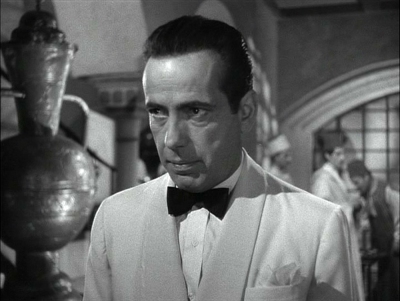
The Meaning of Bogart


Is the popularity of Humphrey Bogart currently languishing? In the 1960s, Bogey-worship reached cultish proportions. His persona – the romantic outsider – accorded perfectly with the iconoclastic spirit of youthful rebellion that characterised the 1960s. Having a poster of Bogart on the wall of one’s student bedsit was the modish cliché of the era – he was seen as a more cerebral, more mature James Dean-figure. It seems to me, however, that his iconic status and popularity are seriously diminishing.

He still has his adherents, but, like Existentialism and Northern Soul, he has been going out of fashion since his 60s zenith, even as his reputation as an actor amongst film buffs and critics remains very high, perhaps higher today than when he was alive. Go to a DVD shop, and you’re likely to find little else other than Casablanca and The African Queen. I’ve looked in many book-shops, but acquiring a biography of him is almost impossible without using the internet. You can find endless Audrey Hepburn, Cary Grant and Marilyn Monroe box-sets in HMV, but Bogie ones are poorly stocked. Shockingly, many of my contemporaries have not even heard of him, or if they have, they have not seen many or any of his films.

This is a very unfortunate state of affairs. To me, Bogart’s work contains a core of moral seriousness, of meaning, that makes him indispensable, absolutely worthy of his iconic status. He is, to put it simply, one of the most compelling figures in the history of film.

Much of his worth, I think, stems from the distinctive ‘Bogie’ persona he crafted for himself, which shaped the scripts he was given and the direction of his films. He was one of very few actors who probably had as much impact on the nature of a picture as the director, simply because of his identity and style. What was this persona, and how did it shape the meaning of his great films? In short, what was the meaning of Bogart?

The first observation to make is that the Bogart persona evolved only gradually, and finds mature expression only in a fraction of the films he made overall. When Bogart first started appearing in films, he was a studio workhorse churning out whatever potboilers the studio demanded in order to earn a bare living. Only gradually did the studios and their writers and directors begin to realise that Bogart was at his most compelling playing certain kinds of roles in certain kinds of films. His partnership with director John Huston really began to draw the best out of him in films such as The Maltese Falcon, Key Largo and The African Queen.

The Bogart persona is defined by two conflicting strands. The first and most obvious aspect of it is his cynicism and apparent selfishness. In film after film he plays characters who, at first sight, are basically jaded, who disclaim any idealistic or romantic notions, who have retreated to a position of self-interest and distrust; who are, in essence, out for themselves, having lost belief in anything bigger than their own individual desires.

The most famous example of this is the character of Rick in Casablanca, who initially tries to tread a path of neutrality between Vichy France/the Nazis, and the Resistance. He is, he proclaims, only interested in making money through his cafe, and, later on, in recapturing the heart of Ilsa (Ingrid Bergman), with whom he previously had an affair in Paris. He claims that he has no interest in fighting the Nazis, and is not prepared to help Victor Laszlo (the fine Paul Henreid), heroic resistance leader and Ilsa’s husband, escape from the Nazis – in fact, he wants to use the letters of transit out of Casablanca that he has acquired to escape from Casablanca himself with Ilsa, whom he still loves. As Rick puts it, “I stick my neck out for nobody!”.

It gradually becomes apparent that Rick may not be the cynical bastard he initially appears to be. Laszlo points out that he ran guns to Ethiopia in 1935 to help in the fight against the fascist Italians, and that he fought for the Republicans against Franco in the Spanish Civil War – in other words, previously he has always helped the anti-Fascist cause, the side of right and justice. He also allows the band to play the Marseillaise in the brilliantly tense scene in his cafe when Laszlo initiates an impromptu sing-off against the Nazi officers who are bellowing a German nationalist song, implying sympathy for the Allied cause.

The final act of Rick’s redemption comes in the famous final scene, when, after planning to escape with Ilsa and leave Laszlo to the depredations of the Nazis (indeed, it even seems that he will betray Laszlo by helping the police arrest him), he abruptly changes his mind and lets Laszlo escape. He even takes a personal risk, forcing Renault, the chief of police, to allow Lazlo’s escape at gunpoint. He thus sacrifices his personal desires – his love for Ilsa and desire to escape from the febrile atmosphere of Casablanca – for a greater cause. His reasoning is summed up in his stirring speech in which he observes that Ilsa must leave because she is vital to Victor, “the thing that keeps him going”, and that if she does not leave she’ll regret it, “Maybe not today. Maybe not tomorrow, but soon and for the rest of your life”. He sums it up by declaring that although he’s “no good at being noble...it doesn’t take much to see that the problems of three little people don’t amount to a hill of beans in this crazy world”. In other words, there is something bigger than himself, a cause worth making sacrifices for. His initial cynical posturing is shown up as a sham, a mask used to protect himself against disappointment. This underlying idealism is the second strand of the Bogart persona.

Rick’s final act of sacrifice is, I think, the fundamental point of the entire film. In its message of hope resides the film’s greatness. Its romance depends on an ending which, in a conventional sense, is ‘unhappy’, but which conveys the great moral that there is always a better and more ethical cause and course of action worth pursuing over mere self-interest. We should try to do the right thing, even when it involves sacrifice or transcending our selfish interests. This message derives all its potency in the film from Rick’s, and therefore Bogart’s, persona. It is only because Rick acts in an amoral, self-interested way to begin with that his final act of altruism seems significant and powerful – his change of heart is the film’s dramatic hinge. Without Bogart and its basically moral message, Casablanca would now be a half-remembered old film that no-one watches.

The message and functioning of the Bogart persona work in the same way in another of Bogart’s greatest pictures, To Have and Have Not, which was his first film with Lauren Bacall. The plot is similar to Casablanca. Bogart plays Harry ‘Steve’ Morgan, a jaded fisherman working in Martinique just after the fall of France in the summer of 1940. Martinique being a French colony, it is under Vichy control. The owner of the hotel in which Harry is living is a resistance sympathiser, who asks for Harry’s help in smuggling some resistance leaders to the island. At first, Harry refuses. He is interested only in running his fishing business, and will not risk helping the resistance, since he knows that if he is found out by the Vichy authorities he will end up imprisoned on Devil’s Island. When asked his sympathies by the Police Captain, he answers, “minding my own business”. Once again, he plays the apparently neutral, amoral individualist not interested in “sticking his neck out” for anyone.

However, when his money is confiscated by the Police Captain and he finds himself broke, he agrees to help the resistance in exchange for payment. In transporting the resistance fighter Paul de Bursac and his wife, Harry’s boat is attacked by a Vichy patrol vessel and de Bursac is shot and injured. They cannot get him to a doctor because the Vichy authorities are scrutinising his every move. Morgan, who has some rudimentary first aid knowledge, agrees to remove the bullet and help save de Bursac’s life. The Vichy authorities try to bribe Harry to betray the resistance members, but he refuses. Harry even overpowers the Captain of Police and forces him at gunpoint to free his alcoholic friend whom they are interrogating, as well as signing harbour passes for de Bursac.

Although Harry Morgan agrees to help at first out of financial necessity, he ends up going out of his way to assist the resistance fighters, as the Vichy authorities’ behaviour begins to offend his sense of justice. The mask of indifference and apolitical individualism once again falls to reveal a basic core of nobility. Asked by the incredulous hotel owner ‘Frenchy’ why he is helping them after his initial indifference, Harry answers, “maybe because I like you, maybe because I don’t like them”. To Have and Have Not does not have the grandeur or drama of Casablanca, but the basic message of a sense of justice trumping self-interest and neutrality emerges once again. The world-weary, hard-headed businessman has a change of heart and realises that basic human decency is something work taking risks for.

The third and last detailed example of the Bogart cynic-idealist dynamic I will explore is Key Largo, one of the fruits of the brilliant Bogart-Huston partnership. In this film Bogart plays a Second World War veteran, Major Frank McCloud, who goes to visit the father and wife of an old comrade who died while fighting with McCloud in the Italy campaign, James Temple (Lionel Barrymore) and Nora (Lauren Bacall). They run a hotel in Key Largo. When McCloud arrives, it quickly becomes apparent that the sinister individuals staying at the hotel are not, as they insist, there for a fishing trip, but are instead gangsters led by the notorious fugitive hood Johnny Rocco, played menacingly by Edward G Robinson. The gangsters are there to complete a big deal, and their identity is quickly revealed by McCloud. They drop the fishing trip pretence, and take McCloud, Temple and Nora prisoner at gunpoint.

At first, once again the Bogart character appears to be selfish and insular. When given a chance to shoot Rocco and send the gangsters packing, he refuses, affecting indifference. He pretends not to care, declaring that “one Rocco more or less isn’t worth dying for”. He is cynical about the idea that Rocco might get his comeuppance, shouting to Nora, “Rocco wants to come back to America, let him! Let him be President!” His apathetic and self-serving attitude is summed up by the typical statement that “I fight nobody’s battles but my own”, a sentiment almost identical to that of Rick in Casablanca and Harry in To Have and Have Not.

However, once again Bogie reveals his true colours and reverts back to the side of justice and decency. Rocco humiliates his alcoholic mistress and causes the murder of two innocent native Americans, which snaps McCloud out of his indifference. He had given up his old hope, for “a world in which there’s no place for Johnny Rocco”, but in the face of such cruelty he revives it, firstly by risking his life to help Rocco’s mistress and then by overpowering the gangsters when they force him to pilot their boat back to Cuba, where Rocco lives in exile. Although McCloud has, intellectually at least, given up on his idealistic hope that “we’re fighting to cleanse the world of ancient evils”, his instincts betray his apathy and he does the right thing. As Nora puts it, “your head said one way, but your whole life said another”.

As you can see, the structure of these films is basically the same. World-weary, cynical Bogie, who claims to have given up on his ideals and his belief in moral behaviour (both personally and politically) for a belief in self-reliant, self-serving amoral individualism, is given a choice; does he do the right thing at some personal risk, or act in a callous and selfish way? Does he stick out his neck, or not? Initially, he acts as his jaded persona would imply, but then he always has a change of heart, ends up abandoning his indifference, and does the right thing. Of course, not all of his film follow this structure (although many do, including The African Queen where Charlie Allnut agrees to ‘stick his neck out’ for Rose in her attempt to help the British war effort, despite his misgivings), but the Bogie persona is given its most concentrated expression in the films underpinned by this dynamic of moral redemption and sacrifice.

The appeal of these themes, which are so brilliantly symbolised by Bogart, can scarcely be seen outside of the context of the era in which the films were made. The despair and apathy that constitutes half of the Bogart persona reflects the circumstances of the 30s and 40s. Ravaged by the Great Depression and the initial successes of Fascism, the world reflected and seemed to reinforce the characteristic Bogie cynicism and abandonment of hope. In Casablanca, Rick’s hopelessness is partly a product of his experience of the defeat of the anti-Fascist cause in Ethiopia and Spain. The initial selfishness and indifference of Bogart in all of these pictures symbolises the despair and fear that engulfed the world of Bogart’s era, a world in which it seemed that all the great ideals and causes had been lost, and so personal survival was the best that could be hoped for. Bogart’s recurrent redemption, his consistent changes of heart, reflect the victory of will and hope over despair that crystallised itself in the war effort, and more specifically, in the American context, FDR’s determination to tackle the Great Depression and also enter the war on the Allies side (it is not a coincidence that Bogart was a supporter of the Democrats and campaigned for FDR).The saviour of Bogey’s soul in the films is an allegory for the saviour of the world from the terrors of Fascism and poverty. It is not difficult to see the appeal of such allegories of sacrifice and morality to audiences making their own sacrifices to win the war.

Indeed, there is a sense in which Bogie becomes a personification of the USA itself. His initial reluctance to involve himself in other people’s battles, his self-reliance, seems to me to be a metaphor for American isolationism and reluctance to get involved in the Second World War. His eventual determination to do the right thing reflects FDR’s attempts to bring the USA in the war, and even the Marshall Plan and post-war reconstruction. I may be in danger of reducing Casablanca to a series of crude national stereotypes, but the character of Rick is clearly, on one level, meant to represent America, just as Laszlo represents Occupied Europe and Major Strasser represents Nazi Germany. In Key Largo, Johnny Rocco is clearly a symbol of the thuggishness and cruelty of Nazism, and Bogart’s eventual conversion to standing up to Rocco, to making a “world in which there is no place for Johnny Rocco”, seems to me to be a metaphor for US involvement in the War. There is, of course, a sense in which this narrative is a piece of self-justifying American propaganda, because the USA only entered the war in 1941 by accident, due to Pearl Harbour and Hitler’s stupid decision to declare war.

It is not fair, however, to reduce the appeal of the Bogart persona and his greatest films to crude political allegory. The figure of Bogart the stoical, self-reliant loner, stalked by disappointment and cynicism, resonates on a far more personal level. Bogart’s characters’ selfishness and apathy is always a product of weltschmerz, of disillusionment, and such disillusion is also a product of personal disappointment that has universal appeal. Rick in Casablanca is a haunted figure not just because of the rise of Fascism and the fact that he is tired of lost political causes, but because he has a broken heart after losing Ilsa. There is a very strong indication that Harry in To Have and Have Not has suffered romantic disappointment – ‘Slim’, the love-interest played by Bacall, asks Bogart, “Who was the girl?” A baffled Bogart replies, “Who was what girl?”, to which Bacall responds, “The one who left you with such a high opinion of women”. Charlie Allnut in The African Queen is clearly a depressive loner, one who finds redemption in the arms of Katherine Hepburn. The treatment of love in the key Bogart films doesn’t always seem consistent. Sometimes romantic love itself is presented as the higher, moral end, which Bogey reaches despite his own cynicism, comparable to the higher moral or political end that Bogey always ends up on the side of, and sometimes love is sacrificed for that higher moral or political end – the former is the case in The African Queen and To Have and Have Not, the latter in Casablanca. However, the appeal of the Bogie persona on this more personal level consists, just as in the more political dimension, in the idea of the disappointed idealist reconciled, perhaps reluctantly or even ill-advisedly, but nonetheless admirably, to his original ideals. The ideal is of love and connection to another individual on the personal level, and of moral connection to the wider community via values such as decency, fairness and justice on the political level. Either way, Humphrey Bogart is the cynic as disappointed romantic par excellence. The romance, the idealism, of course, gains its power from the cynicism, the struggle against its irresistible pull. Straightforward idealism untainted by moral ambivalence and conscientious struggle is no idealism at all.

These themes are not all that is appealing about Bogart. His outsider mentality, which permeates from his real personality into his film roles, gives him a rebellious tinge. The characters he played tended to be infused with impatience with pretension and authority – Bogie plays by no rules other than his own. Since we know that Bogart was notoriously outspoken in his dealings with studios, and renowned as a bit of a firebrand, we can once again see Bogart’s fiction and reality merging into one. Furthermore, his persona cannot stand the credulous, emotionally craven or dependent. This gives his roles a sexual charge that is absolutely unmistakable, particularly as it manifests itself in another characteristic that he himself had, that is, attraction to strong –willed, feisty women. This reaches its peak in the films he made with Bacall, which simply fizzle with incredible sexual chemistry. The scenes in which Bogie and Bacall flirt, particularly the scene in The Big Sleep with the outrageous horse-racing innuendo (“A lot depends on who’s in the saddle”) and the scenes in To Have and Have Not with the cigarettes and whistling double entendre (“You just put your lips together and blow”), are probably the most erotically charged scenes in the history of cinema (the sexual aspect of Bogie is reflected in Woody Allen’s excellent picture Play it Again, Sam, in which Bogart appears as a kind of ghostly romantic mentor to Allen’s hopeless neurotic). Another compelling aspect of Bogart was the fact that one also gets the sense that he was an intelligent and interesting person beneath the acting roles. The fact that he was a very good chess-player (the chess scene in Casablanca was his idea), almost of master strength, adds to his almost never-ending layers of cool.

However, the meaning of Bogart, and the basis of his enduring importance, is undoubtedly his cynic-as-disappointed-romantic persona, which is timeless. So long as human beings pitch hope and will against disappointed ideals and disillusion, those classic films will always be tremendous works of art. Indeed, in a world marked by deep uncertainty and instability, in which all the best causes are the lost ones and a fatalism and despair comparable to the 1930s is emerging, maybe Bogart’s time is coming again. I hope so.

Friday, 9 October 2009

Labour confounds expectations in March West

North East Cambs Labour this evening defied gloomy expectations in a by-election in March West by smashing the Lib Dems and coming a respectable second. The Tory won 830 votes, Martin Field, the Labour candidate, won 460 votes, and the Lib Dem got a measly 250 votes.

Bearing in mind that in the County Elections earlier this year Labour received 177 votes in the same ward/division, and the Tory got 1175, this is a good result. The Lib Dem vote also went down 27 votes from 277. I'm no psephologist, but this is a big swing to Labour.

Previously, on Vote2007.co.uk all of the so-called 'experts' predicted that Labour would get less than 10% of the vote. We actually got 31%, almost double the Lib Dem percentage.

Why did Labour perform so unexpectedly well? Firstly, we fought a hugely energetic and enterprising campaign. Peter Roberts, Labour PPC for North East Cambs, and Chris Jones organised a focused and professional effort, which saw us knocking on 1500+ doors in a month, putting out 3 leaflets and a day of poll, and conducting a decent knocking-up operation on the day. All credit to them for throwing their energy into such a seemingly hopeless cause.

Perhaps the most important factor was the sheer quality of the candidate. Martin Field is a long-serving Geography teacher at the local Neale-Wade community college. He helped set up Young People March, a scheme designed to give youngsters in March something to occupy themselves. He has chaired Fenland Victim Support. He is Chair of Governors at a local primary school. The number of schemes and projects he has selflessly dedicated himself to for the good of the community is tremendous. He is the sort of bloke without whom local communities and civil society would wither on the vine. He's also a really nice man personally, feeding and watering us activists without complaint. Canvassing, it became a running joke that virtually everyone we talked to had either been taught by him, or had children who had done; the reaction to him in this capacity was overwhelmingly positive;he must be one hell of a teacher. If he had been an independent, he would have stormed home to victory.

Another noticeable factor was the quality of the literature we put out. I say without a shadow of a doubt that the leaflets put together by the Roberts/Jones duo were superior to anything the national party managed to put out in the whole Norwich North by-election - glossy, full colour, well-designed, with sharp, to the point copy. I'm not sure whether this says more about Peter and Chris - the Batman and Robin of Cambridgeshire politics - or the national party.

Anyway, the by-election was great fun and a real blow for the Lib Dems. Without the Lib Dems, Labour would have stood a chance of actually beating the Tory. It shows what a spent force the Libs are in North East Cambs, and gives impetus to the argument that only a Labour vote can beat the Tory in Fenland.

Wednesday, 7 October 2009

Times are Toff for Cambridge University Tories

Many Cambridge students may have noticed that Cambridge University Conservative Association (CUCA) has been distributing a university-wide ‘Fresher’s Guide’ in the past week or so. Glossy, full-colour and ten pages, it shows just how well-funded the Conservative Association, and indeed the Conservative Party in general, is. Interestingly, on the first page CUCA gives ‘special thanks’ to Jeffrey Archer, presumably for the production of the booklet. Whether the help given was financial or otherwise, it is obviously true that CUCA have been accepting aid from a convicted criminal, perjurer, liar and fantastist, possibly the most discredited and hated man in British politics.

This is nothing to the content of the booklet. It contains articles on the best options for buying champagne in Cambridge, an article giving (extremely pretentious) tips on formal wear, including tips on handkerchiefs as fashion accessories, cummerbunds and bowties, as well as advice on black and white tie, reviews of a range of restaurants including swanky ones most normal students could only dream of attending, and a guide to tying a bow tie. It projects a fantasy image of a gilded, privileged Cambridge that only ever existed, insofar as it did at all, for a small number of extremely wealthy people. It may appear to be tongue in cheek, but given how seriously CUCA members take these absurdities (as I hear from a source I have inside CUCA), it is not.

In the context of a global recession where ordinary working people are losing their jobs and homes, the Tories are clearly most interested in flaunting their wealth and privilege, and frankly it makes me sick. I’m most worried about my mum losing her livelihood and home if her public sector job gets the axe under the Tories. The Tories live in a cloud-cuckoo land where one can ‘save water’ by ‘drinking champagne’, where the colour of one’s cummerbund or silk handkerchief is more important than making a living, where mummy and daddy can pick up the tab for nights of orgiastic excess.

What kind of image does this project to working class freshers or potential applicants to Cambridge? It re-affirms every stereotype bandied about concerning Oxbridge snobbery, elitism and Brideshead-style excess. CUCA is single-handedly going about the task of setting back access by about 70 years. Cambridge, the Tories imply, is a place for ‘people like us’, people who can afford and enjoy posh restaurants, champagne and white tie. It’s not for the likes of you, people from ordinary working class backgrounds – this is the whole message of CUCA’s sermon. In short, they have squarely positioned themselves as a glorified social club for wannabe toffs, social climbers and minor aristocrats.

The Labour Club is campaigning for the People’s Charter, a manifesto for change that will give ordinary working people a fair chance, a sane economy and a new moral start. We are concerned about bread-and-butter issues because we know that life isn’t one long round of white-tie dinners, champagne receptions and aristocratic indulgence for most people. In the context of a Tory Party led by a small clique of Old Etonians who frequented the Bullingdon Club, that bastion of wealth and privilege in Oxford, CUCA’s cavalier and supercilious attitude is perhaps hardly surprising, but it is shocking and shows just how profoundly alienated from the lives of ordinary working people the Tory Party is.

Wednesday, 16 September 2009

Partisanship, democracy and local elections

I am as partisan politically as the next party activist. I would never seriously contemplate voting anything other than Labour, unless there was no Labour candidate on the ballot paper (which is highly unlikely, as I would probably be the paper candidate myself if I lived in the ward). Even though I have problems, to say the least, with government policy, and am unlikely to ever agree with the party on every issue, I believe profoundly in staying in the party and arguing my case, because there's no other platform for the mainstream social democratic left, and every time someone like me leaves the party, the voice of the left in the party is weakened further. Whatever problems I do have with the party leadership, they pale in comparison with the hatred I have for everything the Tory party does and could ever stand for.

And I undoubtedly think that partisanship is undervalued. It is often criticised on the basis that it means the interests of the country are subordinated to narrow party political concerns - this criticism has been made by numerous commentators in light of the expenses scandal particularly. However, those who attempt to provide an 'apolitical', statesmanlike alternative to the petty squabblings of party politics are usually using this veneer of neutrality to hide some agenda or another - the Jury Team, for example, are funded by Paul Judge, who is a right-wing businessman. The Jury Team claims that its candidates are independents united only by a contempt for the corruption and unpatriotic partisanship of existing parties. However, if that is the case then how can they stand as a legal political party? Why not just stand as independents? What purpose does the Jury Team label serve? If that is not the case and they are another political party, with Paul Judge's backing it does not take a genius to work out what its likely ideological stance will be. The Jury Team either stands for too little or too much. Any candidate or party standing for election must have some position on the issues, and ultimately in competitive elections the Jury Team will succumb to the competitive pressures of party partisanship and be just another party, or it will amount to nothing meaningful.

Partisansip is the price we pay for a relatively accountable democracy. Anti-party political appeals to national unity are the stuff of authoritarians who actually abhor the messy, pluralistic business of competitive elections - witness the various rumoured plots to replace Harold Wilson's governments in the 60s and 70s with a national government under a range of dictatorial nutjobs, and Adolf Hitler's blaming of Germany's problems on the partisan disputes encouraged by Weimar democracy. Yes, sometimes governments will endanger the long-term interests of the country for short-term party advantage, but the alternatives are far worse. Representative democracy is the only game in town, realistically speaking, in large, modern nation states, and despite the much-vaunted decline of the political party, no-one has formulated an alternative means of configuring competing interests and policies in a range of different areas into a platform for governing the country, and then implementing it. Parties as a basis for political organisation and government in a democracy are not perfect, but they are unavoidable.

However, there is an area in which I think there is too much party-orientated partisanship. I can't help thinking that party labels in local elections are often more trouble than they are worth. Now, I am not denying that ideological issues are at stake in local politics - although district/borough councils have been so gutted of important functions that they are nowhere near as ideologically driven as once they were. However, the problem is this. All the parties have effective long-serving local councillors who have developed an excellent relationship with their local community and have the best for their patch at heart. They have the knowledge and experience to provide useful opposition/governance and scrutiny, and to represent their consitutents forcefully. When the national trend goes strongly against their party, they often lose their seats to inexperienced candidates who do not have the experience or skills to do the best job for the people who elected them. Communities lose excellent local servants because too many people use local elections to give incumbent governments a good kicking. Sometimes candidates can buck national trends because of a personal vote, but all too often this is not enough. For example, in my home town of Chelmsford, until 2007 we had two Labour Councillors left, Bill Horslen and Adrian Longden. They were experienced and knowledgeable, and were well-regarded even by Conservatives, who acknowledged that they knew a lot about Marconi and its problems, and forcefully represented their interests. In 2007 they lost their seat to glorified Lib Dem paper candidates, who have little or no idea of the issues facing Marconi, because of the national trend against the Labour Government.

Now, this is a somewhat self-interested line of argument, it could be argued. I am a Labour activist, and Labour has suffered from this phenomenon the most (indeed solely) in recent years. However, in the long run it works both ways. In 96-97 a lot of Labour paper candidates defeated incumbent Tories and subsequently were not the best servants of their wards. It would have been better for local people if long-standing, experienced Tory councillors in basically Conservative areas had kept their seats, because they were the best, most experienced local servants at the time, so long, of course, as this was in the context of the council still being controlled by Labour (jesus, that was a difficult last sentence to write).

So, maybe it would be best if candidates in local elections were not allowed to stand under national party labels. Maybe they could stand as locally-orientated parties on the basis of a local platform, and maybe even local branches of national political parties could campaign for or affiliate to these local parties. The key point is that candidates should not be listed purely on national party labels, because they are then liable to be thrown out on the basis of irrelevant national issues, not local service. It would force voters to actually read candidates' manifestos and vote on local issues important to them, rather than voting lazily on the basis of vague national preferences and prejudices.

(Some credit must go to Tim Worrall, a Tory mate of mine, who floated the idea of reduced partisanship in local politics to me)